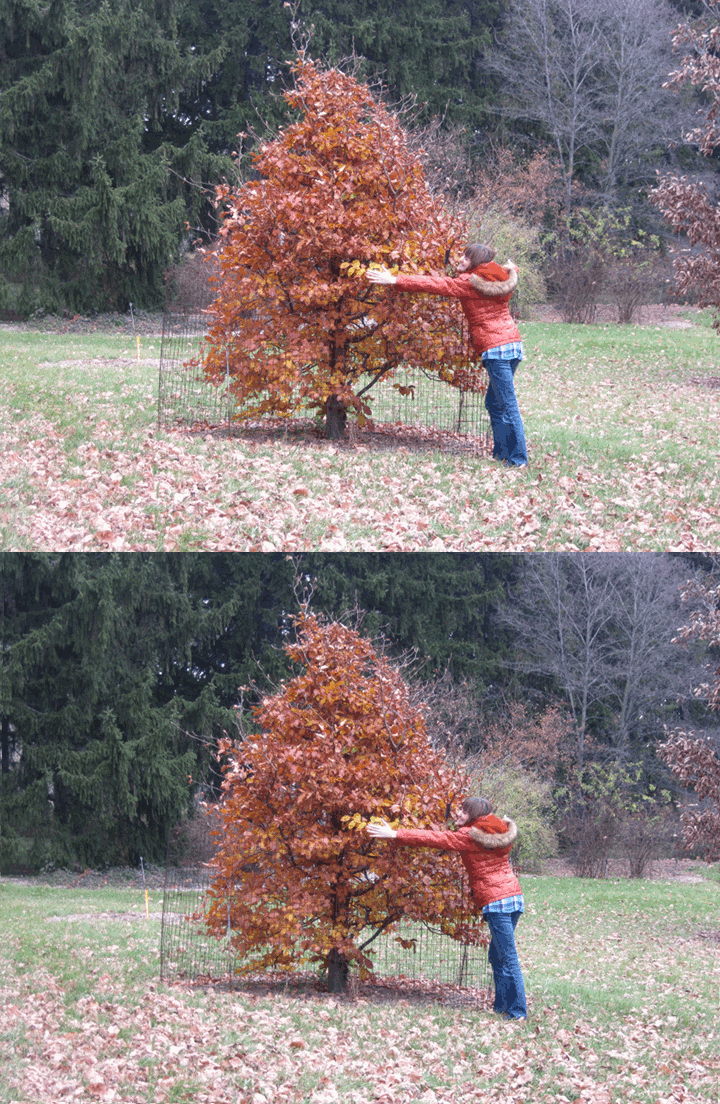
Help a Brotha out!
2008-02-27
Poverty, Crime, and the space you live.
We often assume socio-demographic reasons for crime in an area such as race, income, and education. With the emergence of GIS technology, studies have been done to investigate whether connectivity of neighborhoods affects income and crime. There have been studies that showed a strong correlation and ones that showed a negative ones.
The architect Christopher Alexander and his theory of centers created a different model of understanding well being in the context of the physical space around you. His idea is that physical space (the actual space of objects and where objects do not exist) has a degree of life to it that can be increased by proper incremental enhancement of centers. Centers specifically are anything that attract the eye. In his book series "The Nature of Order", Alexander explains several practical ways of increasing the life of centers and therefore increasing the life of a specific location. How this affects our mood and consciousness can be scientifically tested and maybe eventually pave a way to construct objects, neighborhoods, and cities that is beneficial for everyone.
It is fun to speculate how our living conditions, architecture, and objects around us can such a great influence over us. Maybe people should start paying attention to the little things around them and notice how they change their mood and perception. If people surround themselves with a lively environment, then surely they will become lively. If we are lively, we may start to have a positive effect on those around us. Even though its difficult in this fast paced world to slow down and pay attention, it maybe beneficial to our mood, health, and eventually our prosperity.
The architect Christopher Alexander and his theory of centers created a different model of understanding well being in the context of the physical space around you. His idea is that physical space (the actual space of objects and where objects do not exist) has a degree of life to it that can be increased by proper incremental enhancement of centers. Centers specifically are anything that attract the eye. In his book series "The Nature of Order", Alexander explains several practical ways of increasing the life of centers and therefore increasing the life of a specific location. How this affects our mood and consciousness can be scientifically tested and maybe eventually pave a way to construct objects, neighborhoods, and cities that is beneficial for everyone.
It is fun to speculate how our living conditions, architecture, and objects around us can such a great influence over us. Maybe people should start paying attention to the little things around them and notice how they change their mood and perception. If people surround themselves with a lively environment, then surely they will become lively. If we are lively, we may start to have a positive effect on those around us. Even though its difficult in this fast paced world to slow down and pay attention, it maybe beneficial to our mood, health, and eventually our prosperity.
2007-11-30
Give Peace a Chance
Mike Gravel.
http://www.gravel2008.us
2007-11-12
About the Ron Paul Revolution
There are certain words that strike a cord with people. Liberty, freedom, revolution. They rub their inner passions the right way. There is an internet thing called the "Ron Paul Revolution". You see, many people are on board with revolution since they are fed up with how this country is headed.
Ron Paul is a diligent supporter of the constitution. So I ask you friends. When has it become revolutionary to follow the rules? The rules of the constitution? "Ron Paul Revolution" is oxymoronic (oxymoron with a little ironic). So please people. Ron Paul has no revolutionary ideas. These ideas have always been with us in the form of the constitution. Ron Paul is not changing the system but following it. Do not be swept away by words such as "Freedom", "Liberty", and "Revolution". Bush went into the war in the name of "Freedom." Think for your selves.
If you really want to see some revolutionary ideas. Watch Mike Gravel give an alternate debate this November 15th starting at 4:30 on:
http://www.ustream.tv/
A link will be posted on http://www.gravel2008.us as well.
The revolutionary idea Mike has is called the National Initiative.
http://www.ni4d.us/
CNN would not let him in the debate because he did not raise $1 Million dollars. Support Mike and let the media know that money is not what is important for a presidential candidate. Let them know that we want is someone with great ideas. Truly revolutionary ideas.
Ron Paul is a diligent supporter of the constitution. So I ask you friends. When has it become revolutionary to follow the rules? The rules of the constitution? "Ron Paul Revolution" is oxymoronic (oxymoron with a little ironic). So please people. Ron Paul has no revolutionary ideas. These ideas have always been with us in the form of the constitution. Ron Paul is not changing the system but following it. Do not be swept away by words such as "Freedom", "Liberty", and "Revolution". Bush went into the war in the name of "Freedom." Think for your selves.
If you really want to see some revolutionary ideas. Watch Mike Gravel give an alternate debate this November 15th starting at 4:30 on:
http://www.ustream.tv/
A link will be posted on http://www.gravel2008.us as well.
The revolutionary idea Mike has is called the National Initiative.
http://www.ni4d.us/
CNN would not let him in the debate because he did not raise $1 Million dollars. Support Mike and let the media know that money is not what is important for a presidential candidate. Let them know that we want is someone with great ideas. Truly revolutionary ideas.
2007-10-07
Violence Compounds
Violence has been said by many to be justified in the name of doing good. "The Iraq war is bringing democracy and peace in the middle east" for instance is a common justification. The trouble I have with saying violence can be used for good is the notion of good.
When you commit violence, you absolutely know you are causing harm, otherwise it would not be violence by definition. With violence, there is a guaranteed "bad" effect in the form of harm you are inflicting. For instance, the Iraq war has caused hundreds of thousands civilian deaths as a result of the violence our troops and Iraqi troops are involved in.
However, how can you "know" of any good created from violence? The good becomes this ethereal ,mental, if not subjective entity.
Often times good is realized in the absence of bad. This black and white polar view of the world is troublesome. However, even with this view it is easy to see one truth related to war.
If Good is realized in the absence of bad, and bad is caused by violence, then good is done by peace.
You cannot do Good by doing Bad.
A good rebuttal might be the argument that the future good created by our violence will out-weigh the bad being done.
However, I think it is foolish to determine the lives of so many people by some hopeful gamble of something so far removed from reality as the concept of "good".
When you commit violence, you absolutely know you are causing harm, otherwise it would not be violence by definition. With violence, there is a guaranteed "bad" effect in the form of harm you are inflicting. For instance, the Iraq war has caused hundreds of thousands civilian deaths as a result of the violence our troops and Iraqi troops are involved in.
However, how can you "know" of any good created from violence? The good becomes this ethereal ,mental, if not subjective entity.
Often times good is realized in the absence of bad. This black and white polar view of the world is troublesome. However, even with this view it is easy to see one truth related to war.
If Good is realized in the absence of bad, and bad is caused by violence, then good is done by peace.
You cannot do Good by doing Bad.
A good rebuttal might be the argument that the future good created by our violence will out-weigh the bad being done.
However, I think it is foolish to determine the lives of so many people by some hopeful gamble of something so far removed from reality as the concept of "good".